GLOBAL MEDITATION STORIES

The Sound That Remembers You

A Himalayan encounter with Tibetan singing bowls, where vibration becomes memory and silence becomes medicine.

BEFORE THE FIRST NOTE

Before the First Note

The morning had not yet become morning. It was that tender hour before light, when the world seems to hold its breath and even the mountains appear to be listening.

Somewhere high in the Himalayan quiet, beyond the ordinary language of travel, I sat inside a small stone monastery wrapped in the thin blue air of Tibet. Outside, the wind moved softly along the prayer flags. Inside, nothing hurried.

A monk entered without ceremony. He placed a bronze bowl before him, not as an instrument, but as if he were setting down a memory. His hands were calm. His face carried the stillness of someone who had made peace with silence long ago.

Then the wooden mallet touched the rim.

At first, there was almost nothing. A faint circle of sound, fragile as breath. Then it widened, deepened, and seemed to move through the room like warm light. It did not ask to be noticed. It simply arrived.


“Some sounds enter the ear.
This one enters the places we forgot to soften.”

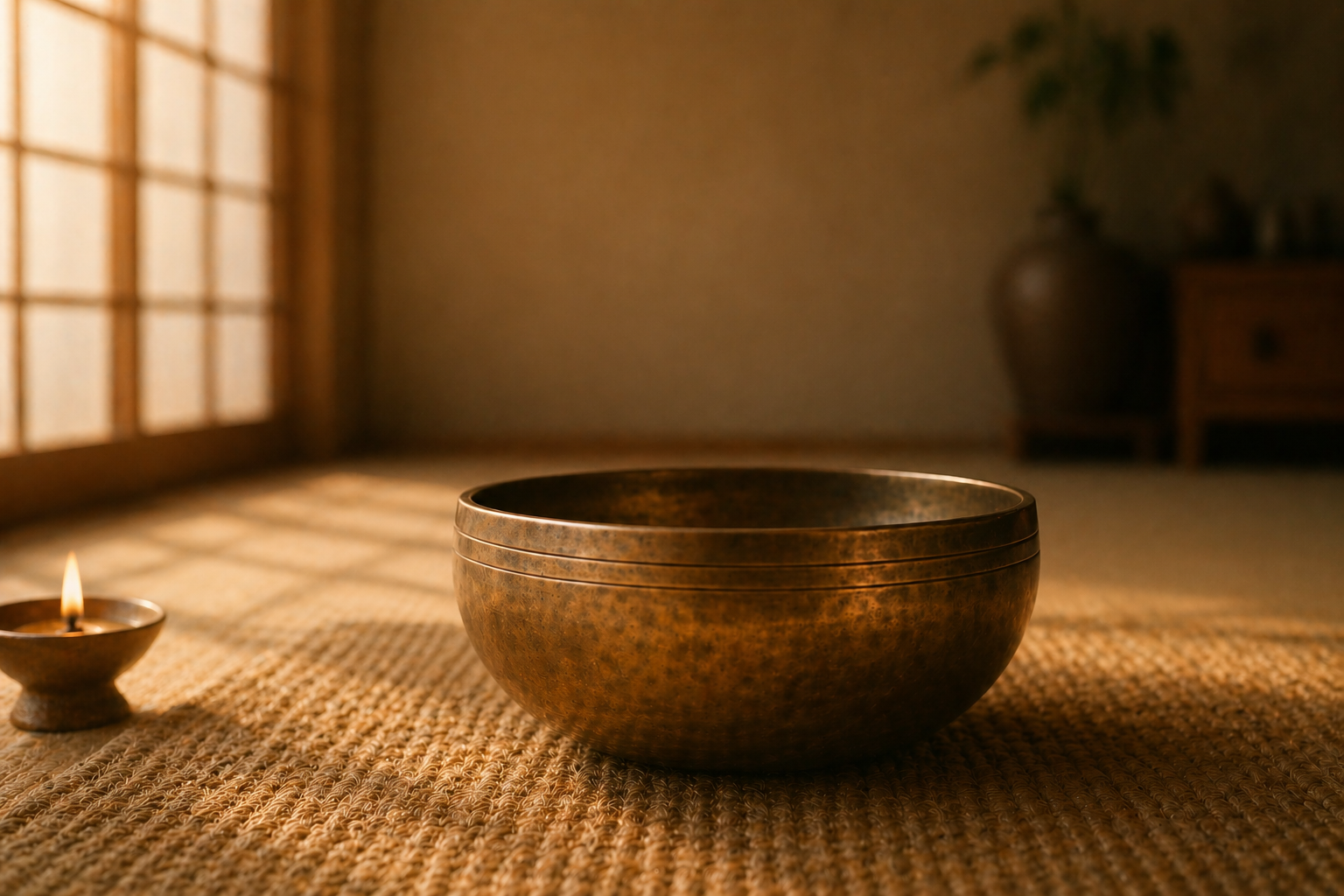
Aged bronze Tibetan singing bowl placed on woven cloth
INSIDE THE BOWL

Inside the Bowl

A Tibetan singing bowl is not merely an object placed in a room. In the right hands, it becomes a small landscape of silence — metal, memory, breath, and time gathered into one quiet circle.

Before the sound begins, there is already a ritual. The bowl rests on woven cloth. Prayer beads lie nearby. A butter lamp trembles gently in the corner. Nothing is decorative here. Everything seems to be waiting.

When the mallet moves around the rim, the sound does not travel in a straight line. It circles. It returns. It deepens. It reminds the body of something older than language: that not every healing arrives through explanation.

The shoulders soften before the mind understands why. The breath becomes slower without being commanded. The heart, so often disciplined by duty, begins to loosen its grip.

This is not entertainment. It is not performance. It is a return — to the body, to the present, to the quiet self beneath the noise of the world.

WHAT THE SOUND AWAKENS

What the Sound Awakens

The bowl does not speak loudly. It simply touches the places where modern life has quietly gathered.

01

The Shoulders

Where invisible responsibility often rests.

02

The Breath

Where the body remembers it is safe.

03

The Heart

Where old heaviness begins to loosen.

04

The Mind

Where silence becomes less frightening.

The Himalayan Memory of Sound

In the Himalayan imagination, sound is not only heard. It is received, held, and allowed to fade into silence. The Tibetan bowl belongs to this quiet world — not as entertainment, but as a small ritual of return.

Tibetan bowl with prayer beads and candle
01

Ritual

Bowls have long been associated with meditation, sacred pauses, and moments of inward attention. Before the sound begins, there is already respect: the placement of the bowl, the quieting of the hands, the softening of the room.

Soft ripples and symbolic vibration
02

Resonance

The vibration moves slowly through the air and into awareness. For many, it becomes a gentle invitation for the body to settle — not through force, but through rhythm, warmth, and repeated listening.

Quiet meditation room with soft morning light
03

Silence

The most meaningful part often arrives after the tone has faded. In that after-sound, silence feels less empty. It becomes spacious, dignified, and quietly alive.

A gentle note: this practice is shared here as cultural reflection and personal stillness, not as medical advice or a promised treatment.

For the Traveller Who Has Forgotten How to Arrive

There are travellers who move through the world with beautiful efficiency. They know the rhythm of airport lounges, hotel corridors, early departures, and conversations held across time zones.

They arrive everywhere — and yet, privately, they sometimes feel they have not arrived inside themselves.

This is where the Tibetan sound bowl becomes more than a cultural object. It becomes a pause for the exhausted successful person: the executive, the founder, the negotiator, the parent, the one who is always expected to remain composed.

This article is not only about Tibet. It is about the modern traveller learning, once again, that stillness is not a luxury after success. Sometimes, it is what allows success to remain human.

Begin the Quiet Ritual
Calm business traveller looking out of airplane window at sunrise

A Three-Minute Bowl Ritual

A quiet return. One sound. One breath. One moment at a time.

Sit calmly
01

Sit

Place your body gently into stillness. Sit cross-legged or grounded. Let the spine rise without effort. Before the sound begins, allow yourself to arrive.

Touch the bowl
02

Touch

Rest your hands on the bowl. Feel its temperature, its weight. Let the connection happen before the sound.

Circle the bowl
03

Circle

Move the mallet slowly around the rim. Do not force the sound. Let it emerge — as if it has chosen its own moment.

Listen deeply
04

Listen

Follow the vibration as it expands and fades. Notice where your body softens. The sound is no longer outside — it is within.

05

Remain

When the sound disappears, do not move. Stay one breath longer. The silence is not empty — it is the completion.

The bowl does not ask you to become someone new.
It simply invites you to return to the person beneath the noise.

Some journeys end with photographs.
This one ends with a sound you may carry quietly for years.

— HealNest