The First Language We Ever Spoke
Long before we learned words, our bodies already knew how to tell stories.
Before a child knows the name of hunger, the body reaches. Before love becomes a sentence, arms open. Before grief is explained, the shoulders lower. Words arrived late. The body had already been speaking for a very long time.

“The body was our first alphabet. Every gesture was once a letter sent toward the world.”
Before Words
A newborn does not enter the world with vocabulary. It arrives with movement. Fingers curl. Knees fold. The mouth searches. The whole small body becomes a message before anyone teaches it grammar. Long before a child says mother, hunger, fear, more, stay, the body has already spoken all of these things.
There is something almost sacred in this. The first conversations of our lives are not made of language but of reaching, turning, trembling, resting, clinging, pushing away, and opening. A baby does not explain loneliness. It cries with the entire body. A child does not announce wonder. It runs toward it.
Perhaps this is why we are moved by simple gestures even after a lifetime of words. An elderly hand searching for another hand. A child asleep against a shoulder. Someone waving from a train window until distance takes over. A person standing very still after receiving news.
The body says what language can only follow.
The World Learned Through Reaching
Childhood is an education in movement. A child learns the world by touching it. Soil between fingers. Water lifted in both hands. The rough bark of a tree. The warm side of a sleeping dog. The secret architecture of cupboards. The dangerous invitation of stairs.
Adults call this curiosity. Perhaps it is more ancient than that. Perhaps it is the body learning its place among things. A child reaches not because someone has explained discovery, but because life itself seems to be calling from just beyond the arm.
Then slowly, often without anyone meaning harm, the world begins to teach restraint. Sit still. Be careful. Don’t touch. Don’t run. Don’t make noise. Don’t take up space. Don’t cry here. Don’t dance there. Don’t show too much.
Some of this is necessary. Civilisation depends on a little self-control. But somewhere in the long schooling of manners, many people begin to lose trust in the first language they ever knew.
“A child moves before it knows it is being watched. Perhaps freedom begins there.”
The Old Human Inheritance
Imagine people before alphabets, before books, before passports, before the names of countries. Imagine them waking with the sun, carrying water, grinding grain, crossing rivers, tending fires, lifting children, following animals, reading the weather through skin and bone.
Their lives were full of movement that meant something. A bow was greeting. A raised hand was blessing. A dance was memory. A procession was prayer. A journey on foot was not simply distance; it was devotion measured in steps.
Across the world, communities danced before they wrote. They circled fires, stamped earth, swayed in grief, leapt in celebration, moved together when language was too small for what needed to be shared.
The cave wall remembers the handprint. The temple floor remembers the feet. The old road remembers pilgrims. The sea remembers fishermen learning balance from waves.
How Emotion Moves
Joy rarely remains seated. It rises. It lifts the face. It opens the hands. It makes the body larger, almost as if happiness needs more room than ordinary life allows.
Grief does the opposite. It folds. It lowers the eyes. It bends the back. It brings the arms inward, as if the body is trying to hold together what the heart cannot.
Shame shrinks. Anger sharpens. Fear freezes. Love leans closer. Relief exhales. Hope looks upward before the mind has prepared a reason.
We speak constantly through posture. Two people can sit in silence and say everything. A shoulder turned away. A hand left open on the table. A chair moved closer. A door closed softly instead of slammed. The smallest gestures often carry the longest histories.
The Body Knows the Weather Before the Mind Names It
Birds open their wings before flight. Trees bend before wind. Flowers open without speeches. Rivers curve because stone and time have spoken to them. Nothing in nature is completely still. Even stillness has a pulse.
So it is with us. The body changes before the sentence arrives. A breath shortens. A face softens. A hand becomes restless. A jaw tightens around words that cannot yet be trusted.
The body is not dramatic. It is precise. It keeps offering little weather reports from the inner world.
We simply became too busy to listen.
When Movement Became Exercise
At some point, many adults stop moving to express and begin moving to correct. Movement becomes measured, scheduled, compared, improved. The body becomes a project. A number. A mirror. A promise made in January and quietly abandoned by February.
There is nothing wrong with caring for the body. But something tender is lost when movement is allowed to mean only fitness. A walk can be grief. A stretch can be forgiveness. A dance in the kitchen can be proof that the day did not defeat us entirely.
The body was never only machinery. It was memory, shelter, messenger, witness, instrument, homeland.
To move is not merely to burn energy. It is to speak again in a language older than explanation.
The Grandmother’s Hand
There are gestures that outlive entire conversations.
A grandmother placing food on a plate even after everyone says they are full. A father standing at the gate until the bus disappears. A mother smoothing a child’s hair before school. An old friend touching the shoulder once, briefly, because more would make both people cry.
Such gestures are not decoration. They are language.
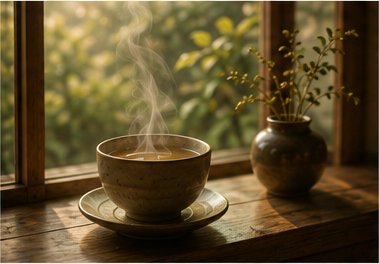
In many families, love was not always spoken fluently. Some people belonged to generations who did not say tender things easily. They had other dialects. Tea placed near the hand. A blanket folded at the foot of the bed. A repaired shirt. A bag packed before dawn. A silent walk beside someone who could not bear advice.
The body knew how to say, “I am here,” even when the mouth could not.
The Silence Between People
Silence is not the absence of language. It is often the place where the body becomes most honest. Sit beside someone in a hospital corridor and you will understand this. There may be nothing to say that is not too small. And yet a hand held, a shoulder offered, a cup brought from a machine in the hallway — these become sentences large enough to live in.
In celebration too, the body speaks before the mind catches up. People clap. They embrace. They lift children into the air. They dance badly and beautifully. They become, for a moment, less careful about the borders of the self.
Perhaps this is why movement belongs to both mourning and joy. The body knows that some truths cannot remain still inside us.
“The body says what the heart cannot risk putting into words.”
Returning to the First Language
We do not need to become children again. That would be impossible, and perhaps unfair to children, who are already doing the difficult work of discovering the world for the first time.
But we can become less estranged from the body.
We can notice the breath before the explanation. The shoulders before the apology. The hands before the habit of hiding them. We can remember that movement need not always be impressive to be meaningful.
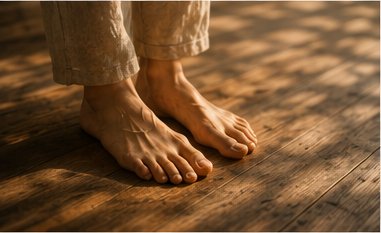
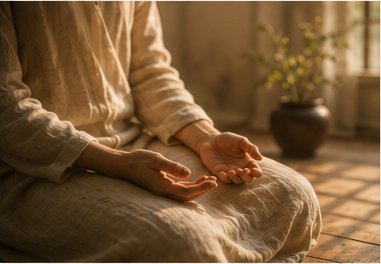
A person standing quietly near a window is moving. A person walking slowly after grief is moving. A person lifting their face toward morning is moving. A person placing one hand on the heart and choosing not to rush for once is moving in a language older than ambition.
Remembering Through Practice
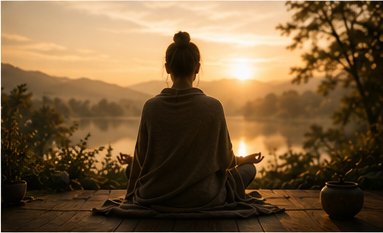
Perhaps this is why a quiet practice can feel familiar even when it is new. Standing. Breathing. Turning gently. Reaching without hurry. Bending not to prove flexibility, but to listen.
Yoga did not invent this first language. It preserves one doorway back to it.
The body does not ask us to become someone new. It asks whether we are willing to hear the person who has been here all along.
If today’s gentle practice continues this conversation, let it begin not with effort, but with remembering.
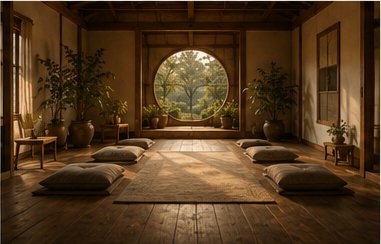
The body does not need a performance. It needs a place where it can finally arrive.
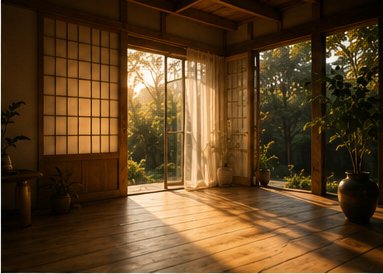
A quiet room, a small pool of light, a mat waiting without demand — sometimes this is enough. Not because it fixes the body, but because it stops asking the body to explain itself.
What Remains Unspoken
Long after words have tired themselves, the body remains.
It reaches. It folds. It trembles. It rests. It opens.
Somewhere inside us, the first language is still alive.
We do not have to translate it tonight.
We only have to listen.
Today’s Quiet Remedy
Warm Lemon Honey Water — warmth returning to warmth, a simple morning welcome for the body.
Enter GentlyToday’s Quiet Companion
Serene Tarana — music that feels like dawn entering an old wooden home.
Listen SlowlyContinue Gently
If your body wishes to continue this conversation, today’s gentle practice begins with remembering.
Continue