Healnest Journal Reflection
The Courage to Lean
Nothing magnificent in the universe has ever stood completely alone.
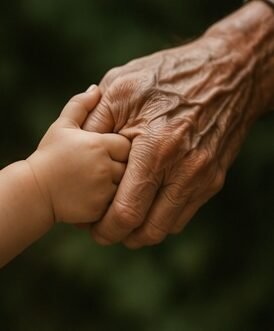
A child holds one large finger and learns to walk. No one calls it weakness. Everyone calls it beginning.
The child was not walking yet.
Not exactly.
He was negotiating with the floor.
One tiny hand held one large finger.
The finger belonged to his grandfather, who had already walked through enough life to know that balance is mostly a conversation with falling.
The child leaned.
The grandfather bent.
They moved across the room together, one small step at a time.
No one watching said, “Stand by yourself.”
No one whispered, “This is dependence.”
No one worried that the child would never become strong because he had once needed a hand.
Everyone smiled.
Because leaning was expected.
Because everyone in the room knew the truth before life taught them to forget it.
A human being begins by holding on.
The old floorboard creaked softly.
“I have carried every one of you,” it said. “Odd how few people introduce themselves.”
Years later, perhaps that same child would apologise for asking someone to help carry groceries.
He would say, “Sorry, I should be able to manage.”
He would say it while holding bags heavy enough to leave red marks across his palms.
He would say it as if needing help were a moral defect rather than a simple matter of weight.
What happened?
When did leaning become embarrassing?
When did asking for a hand begin to feel like a confession?
The universe, which had been listening for a very long time, seemed mildly amused.
“Humans built chairs,” it observed, “then apologised for sitting down.”
“Curious species.”
A chair nearby said nothing.
Chairs are used to this.
They spend their lives being useful and receive almost no poetry.
Still, they do not complain.
They simply wait under tired bodies with the quiet patience of saints.
Perhaps that is what support often looks like.
Not dramatic.
Not announced.
Just there.
Human beings admire independence.
Nature appears to admire relationships.
The tree leans toward light.
The flower leans toward warmth.
The river leans downhill.
The cloud leans upon wind.
Snow leans upon mountains.
Vines lean on old walls and somehow everyone calls them charming.
No one tells ivy, “You should really learn to stand alone.”
No one asks a river to be more self-sufficient.
No one scolds morning mist for needing the valley.
An ancient oak stirred its leaves.
“Forests have never held conferences about teamwork,” it said. “We simply do it.”
Beneath the soil, roots touched roots.
In redwood forests, the tallest trees on earth often survive not because their roots are deep, but because their roots are intertwined.
They hold one another against storms.
They become tall by refusing to be separate.
This sounds like a secret.
It is not.
The forest has been telling us for centuries.
We merely called it scenery.
Birds know this too.
Geese fly in formation because air itself becomes kinder when shared.
The bird in front breaks the wind.
When it tires, another takes the lead.
No speech.
No medal.
No motivational poster.
Just wings, trust, and the ancient intelligence of not making one creature carry the whole sky.
Roots · Wings · Hands · Home
Even your heartbeat learned rhythm in the presence of another heartbeat.
Before you knew your own name, before you had opinions, before you had goals, your nervous system was already listening.
A trusted presence can calm the body.
A warm voice can slow the storm inside.
A hand held at the right moment can tell the heart what language has not yet found.
Science says this in careful terms.
Grandmothers have always said it by putting tea on the table.
The tallest trees do not survive by standing apart. They survive by holding one another where no one can see.
History has always understood what modern pride finds difficult.
Stone cathedrals rise because every stone accepts the weight of another.
Roman arches stand because each stone presses gently into the next.
Remove one piece, and grandeur remembers humility.
Old bridges do not pretend to float.
They lean into banks.
They trust their stones.
They carry strangers across water without asking who deserves passage.
An old bridge spoke from the mist.
“I have never crossed a river myself,” it said. “I exist so others can.”
In old villages, neighbours raised one another’s homes.
Farmers harvested together because grain has never cared for personal branding.
Tea was served across a table, not performed into emptiness.
Japanese temples learned to survive earthquakes not by becoming rigid, but by yielding.
There is wisdom in bending.
There is wisdom in joints.
There is wisdom in knowing that what refuses to move may be the first thing to break.
A staircase interrupted.
“People praise the view from above,” said the staircase. “But they rarely thank the steps.”
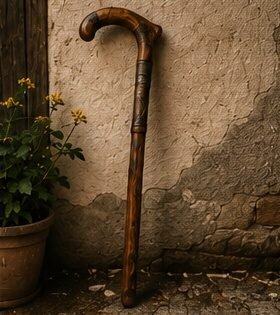
The walking stick near the door nodded, though no one noticed.
It had heard this sort of thing before.

Humans invented umbrellas.
Then somehow decided that asking for emotional shelter was weakness.
Humans invented social media.
Then forgot how to knock on a neighbour’s door.
Humans admire lighthouses.
Then hesitate to say, “I am lost.”
The lighthouse, being more practical than most people, found this confusing.
“My entire purpose is to be seen by those who cannot find their way,” it said. “Why would anyone be ashamed of looking?”
There is a kind of loneliness that wears polished shoes.
It answers emails quickly.
It says, “All good.”
It carries too many things at once.
It laughs before anyone can ask what hurts.
It has strong shoulders and a tired face.
Many people have lived there.
Some still do.
They became dependable and forgot they were allowed to be held.
They became useful and forgot they were also beloved.
They became the bridge and forgot they were allowed to cross.
What if strength was never meant to mean carrying everything alone?
What if strength was also knowing where to place the weight?
Somewhere, an elderly couple walks slowly down a street.
Neither one is leading.
Neither one is being led.
They are simply leaning into the same afternoon.
Somewhere, friends carry a sofa up three flights of stairs, and the sofa, which has no manners, becomes wider at every landing.
Everyone laughs.
Someone says, “Tilt it.”
Someone says, “No, the other tilt.”
For ten difficult minutes, friendship is furniture logistics.
And somehow, that too is love.
Support is often the art of appearing ordinary while quietly preventing collapse.
Then the humour begins to soften.
Because leaning is easy to discuss when it is a bridge, a chair, a vine, a goose.
It becomes harder when it is you.
When the bag is too heavy.
When the diagnosis has too many syllables.
When the house is quiet after the funeral.
When the child has grown but still needs you.
When the parent has aged and now needs the steadiness they once gave.
When the apology has waited too long.
When the sentence “I’m not okay” stands at the back of the throat like a shy visitor.
Somewhere, a nurse holds the hand of someone whose family has not yet arrived.
Somewhere, a mother stays awake beside a feverish child, measuring the night by breathing.
Somewhere, a father runs behind a bicycle, one hand on the seat, pretending he is not tired.
Somewhere, someone finally says, “I cannot carry this alone.”
And someone answers, “Then don’t.”
No music rises.
No clouds part.
But the room changes.
The weight does not disappear.
It becomes shared.
And shared weight is still weight.
But it no longer has the same loneliness.
There are people who held you together so quietly that you mistook their love for the weather.
Maybe you are remembering one now.
A teacher.
A neighbour.
A brother.
A friend who stayed past convenience.
A mother who said little and did everything.
A father whose love arrived disguised as repaired things.
A spouse who noticed what you did not say.
A stranger who made one unbearable day slightly less unbearable.
Some people do not save us dramatically.
They sit nearby.
They bring food.
They drive us home.
They remember the appointment.
They leave the porch light on.
They become the railing we use without thinking.

Perhaps today’s gentle practice is not about becoming stronger.
Perhaps it is about discovering what has quietly supported you all along.
The floor.
The breath.
Gravity.
Kindness.
The person who said, “Text me when you get home.”
The silence that did not demand an explanation.
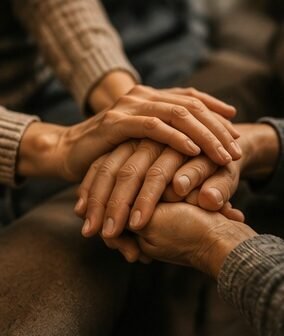
The hand that did not fix you, but did not let go.
Maybe healing begins the moment we stop pretending we stand alone.
Maybe courage is not always a straight back and clenched jaw.
Maybe courage is a softer sentence.
“Can you stay with me for a while?”
There are sentences people remember for years.
This may be one of them.
Not because it is grand.
Because it is true.
Nothing magnificent in the universe has ever stood completely alone.
Not forests.
Not bridges.
Not cathedrals.
Not children.
Not hearts.
Not you.
You were never weak for needing a hand.
Even the most beautiful bridges
lean into both shores.
Strength is not refusing to lean. Strength is knowing what has been holding you all along.
🌿 Today’s Quiet Remedy
Warm oat straw tea is the kind of comfort that never insists on being noticed.
It sits quietly beside the evening like a friend who knows conversation is not always necessary.
A simple cup. A steady warmth. A small reminder that being held can sometimes feel as ordinary as steam rising from the table.
🎵 Today’s Quiet Companion
Music that feels like two people walking the same forest path without needing to speak.
No urgency. No explanation.
Only footsteps, breath, and the kindness of not being alone.
🌅 Continue Gently
If today reminded you that strength sometimes arrives wearing the face of kindness...
perhaps keep walking.
Not alone. Simply gently.