Healnest Journal · Papua New Guinea

When the Skin Remembers Who You Are

Across Papua New Guinea, body painting is more than visual beauty. It is identity made visible — a language of land, lineage, ceremony, pride, and human belonging.

Culture & Identity Global Healing Stories Magazine Feature

There are cultures where identity is carried in surnames, passports, uniforms, and LinkedIn titles. And then there are cultures where identity arrives first on the skin.

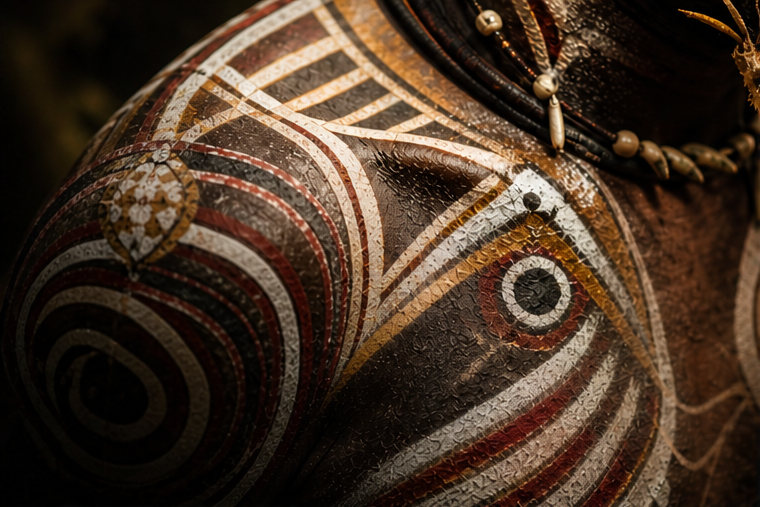
Close-up of Papua New Guinea body painting texture
Pigment, hand, skin, memory — identity begins as texture before it becomes meaning.
The first language

Before the voice, the body speaks

In Papua New Guinea, a painted face can enter a space before the person has said a single word. It can announce place, occasion, courage, ancestry, beauty, warning, welcome, transformation, or memory. To the hurried visitor, it may appear theatrical. To the impatient tourist with a camera already raised — humanity’s most enthusiastic form of blinking — it may look like spectacle. But the truth is richer, older, and far less convenient.

Body painting here is not merely decoration. It is a cultural grammar. It can hold signals of community, ceremonial role, age, gender, clan, region, status, and spiritual worldviews. Its meanings are not universal across the country because Papua New Guinea itself is not one single story. It is a nation of extraordinary diversity, with highlands, islands, forests, valleys, coasts, and communities whose customs cannot be flattened into one tidy postcard.

And that, frankly, is part of the beauty. Modern culture adores simplifying things until they fit inside a brochure. Papua New Guinea refuses to be reduced so politely.

The painted body is not asking to be consumed. It is asking to be recognized.

Natural pigments, earth colors, clay, ash, charcoal, plant-based materials, feathers, shells, leaves, and handmade adornments may all become part of the visual language. The body is not separate from landscape. The person does not stand outside nature as a visitor. The person carries nature forward as identity.
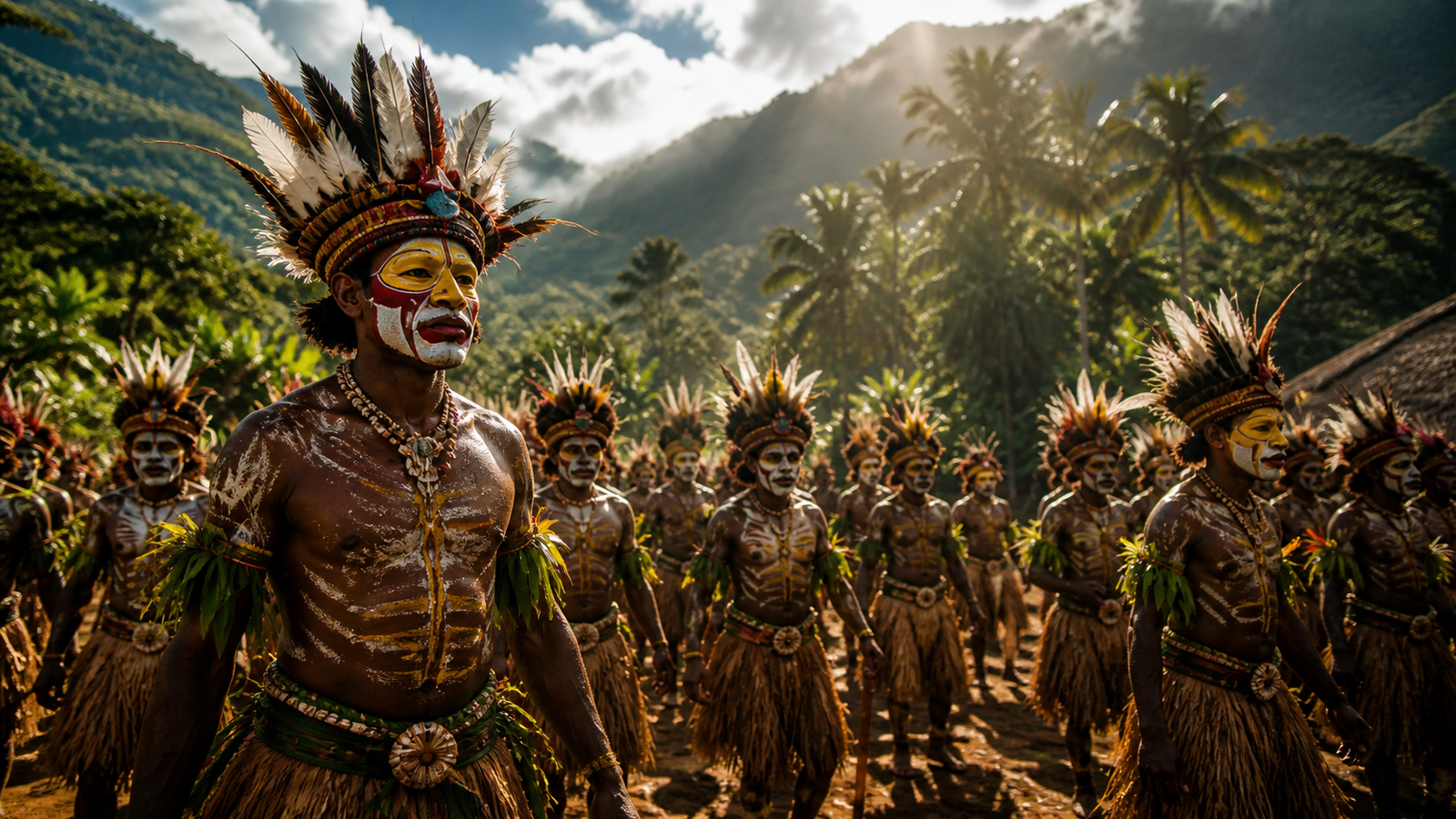
Papua New Guinea ceremonial gathering

Not performance. Presence.

At cultural gatherings, what appears to outsiders as spectacle may be, for the community, continuity — a living archive of ancestry, place, pride, and belonging.

A country of many worlds

The mistake is thinking there is one story

Papua New Guinea is one of the most culturally diverse countries on earth. Its traditions vary dramatically from one community to another. In the highlands, ceremonial adornment may feel grand, vertical, feathered, and intensely dramatic. In other regions, patterns, materials, and meanings shift with local histories, landscapes, social roles, and spiritual relationships.

This is where the outsider must slow down. Not everything that looks similar means the same thing. A stripe is not always “a stripe.” A color is not merely “pretty.” A feather is not simply “exotic,” a word that should have been retired shortly after colonial luggage trunks and men confidently drawing maps of places they did not understand.

The wiser approach is humility. To look closely without pretending to own the meaning. To admire without grabbing. To understand that some symbols are not waiting to be translated for us.

Some cultures write history in books. Others keep it moving — on skin, in song, through ceremony.

Healnest Journal

This is what makes body painting such a powerful cultural form. It is temporary, yet deeply rooted. It may last only for a ceremony, a gathering, a dance, a rite, or a public moment — but its meaning may come from centuries of continuity. The paint may wash away. The belonging does not.

Symbolic patterns painted on skin
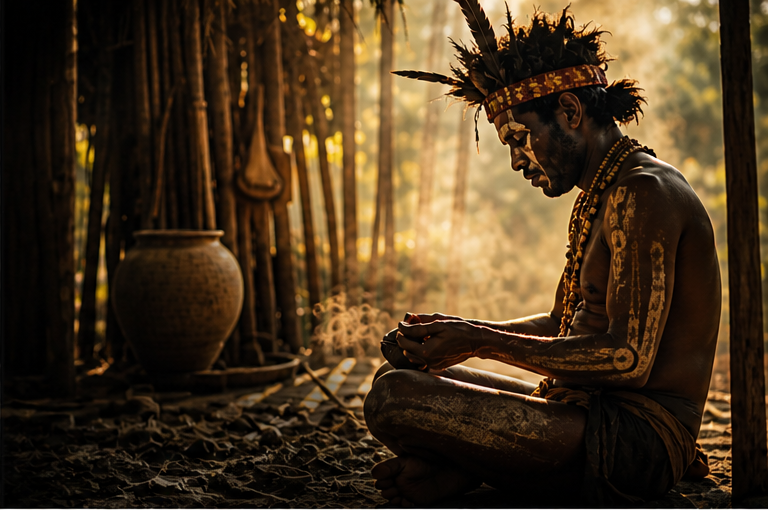
Quiet preparation before ceremony
Why painting heals

Identity is not always private

In many modern societies, identity has become oddly bureaucratic. We prove ourselves with cards, passwords, job titles, school names, income brackets, email signatures, and tiny profile photos where everyone is trying to look relaxed while clearly not being relaxed at all.

Body painting offers a different philosophy. Identity is not hidden inside a file. It is embodied. It is communal. It is prepared, witnessed, and carried. The body becomes not an object to improve but a place where memory is allowed to appear.

This is where its emotional power lies. To be painted by another person, or to appear before one’s community in a recognized visual language, is to experience identity not as a lonely internal concept but as something affirmed by others. “You are from somewhere.” “You stand within something.” “You carry more than yourself.”

Healing begins when a person is no longer forced to disappear from their own story.

In that sense, body painting speaks far beyond Papua New Guinea. It touches something universal. All of us, in quieter ways, are trying to remember who we are beneath the acceptable versions we perform. The polite version. The office version. The family-peacekeeping version. The “I am fine” version, which deserves an international award for most overused fiction.

Color, pattern, and authority

The body as a living archive

The colors used in body painting often carry emotional and symbolic force. White may evoke ash, spirit, light, or ancestral presence. Black may bring gravity, protection, intensity, or grounding. Red can suggest vitality, blood, energy, or life force. Yellow, ochre, clay, and earth tones connect the visual field back to land and material life.

But the meaning is never as simple as “red means this” and “white means that.” Culture is not a supermarket label. Meaning depends on community, occasion, relationship, and context. A mark may be aesthetic, ceremonial, protective, celebratory, ancestral, humorous, intimidating, or all of these at once. Human beings, inconveniently for simple explanations, are complicated.

Patterns may follow the curves of the face, the shoulders, the chest, or the arms. Some feel geometric and architectural. Others seem to move like rivers, vines, wings, or animal forms. The body becomes a landscape of signs. Skin becomes page, mask, memory, and stage — all at once.

Land

Many materials are rooted in earth, plants, ash, clay, minerals, and the surrounding environment.

Lineage

Visual identity can connect the individual to family, community, place, role, and inherited tradition.

Ceremony

Painting often appears in moments when ordinary time becomes communal, symbolic, and memorable.

The modern gaze

When the camera arrives too quickly

There is a delicate tension around cultural visibility. Festivals and gatherings can invite admiration, tourism, pride, documentation, and economic opportunity. They can also invite misunderstanding. The world loves to look; it is less talented at listening.

A painted face on a screen may become “content.” A ceremony may become “color.” A person may become “the shot.” This is the small tragedy of modern attention: it often mistakes access for understanding.

To witness traditions like these well, we must practice a better kind of seeing. Not the hungry gaze that collects images. Not the lazy gaze that turns living culture into decorative mood-board material. But the patient gaze — one that can say, “This is beautiful, and I do not need to own it.”

Respect begins where consumption slows down.

The painted body does not exist to flatter the visitor. It exists within its own world of meaning. Our task is not to reduce it, but to let it remain larger than our explanation.

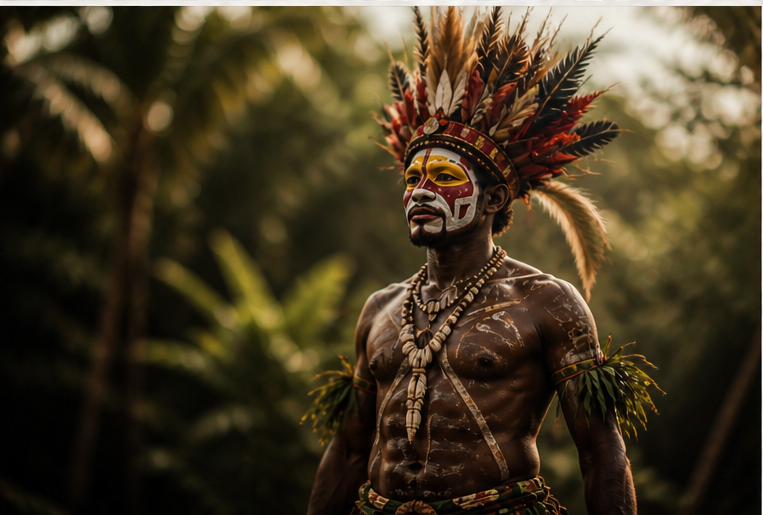
Painted person standing with dignity

Seen without apology

To carry identity visibly is not a small act. It is a declaration that belonging does not need to be hidden to be dignified.

What it leaves with us

The wisdom beneath the paint

The lesson is not that everyone should paint their face and walk into Monday’s budget meeting with ceremonial intensity — though, depending on the meeting, one understands the temptation.

The lesson is quieter. It asks what modern life has made us erase. What part of ourselves we have hidden to become acceptable. What ancestral, emotional, linguistic, cultural, or personal colors we have politely washed away.

Papua New Guinea’s body painting traditions remind us that identity is not merely an internal mood. It can be carried, witnessed, celebrated, and returned to. The body is not just a biological fact. It is a home for story.

And perhaps that is why these images stay with us. Not because they are dramatic, though they are. Not because they are visually magnificent, though they certainly are. They stay because they remind us of something many people secretly miss: the feeling of belonging without needing to explain every part of ourselves.

The paint may fade. The remembering remains.

In the end, this is not only a story about color on skin. It is a story about what human beings do when they refuse to let identity become invisible. They mark it. They carry it. They gather around it. They let the body remember what the world is always trying to make us forget.